Case Study: Digital Competency Development in the Banking Sector
Business Context
The bank we are working with faced a challenge well-known across the entire financial sector. The digitalization of processes was progressing faster than the actual verification of employee competencies. On one hand, regulatory and technological requirements were increasing; on the other, there was a lack of reliable data regarding the actual level of digital proficiency within teams.
Previous development initiatives relied primarily on self-declarations, completed training sessions, and the number of hours spent on courses. There was no objective benchmark to answer fundamental questions: what can employees actually do, where are the gaps, and which development activities truly make sense?
Implementation Goal
The project’s objective was to create a consistent, repeatable process for verifying and enhancing the digital competencies of the bank’s employees. The key was to bridge diagnosis with development and provide managers with reliable data for decision-making.
The Outcome Skills platform was utilized to achieve this goal.Do realizacji tego celu wykorzystano platformę.
Scope and Implementation Stages
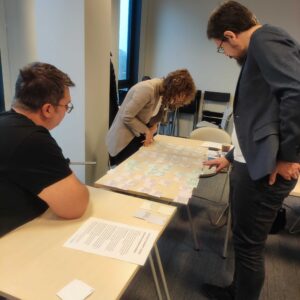
The rollout was planned in two stages, corresponding to the organization’s actual needs. Before commencing each stage, core and specialized digital competency models were created to serve as the foundation for the assessments.

Stage One
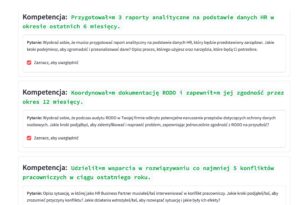
This stage involved assessing core digital competencies, with a particular focus on MS Office tools. Tests were prepared to verify practical skills in working with documents, spreadsheets, email, and team collaboration tools.
Stage Two
This stage addressed specialized digital competencies directly related to operating internal banking systems. The tests were designed to reflect real-world tasks performed in daily work, rather than just declarative knowledge.
Before launching the tests across the entire organization, a pilot was conducted with a focus group. This allowed for the verification of difficulty levels, the alignment of questions with actual processes, and the refinement of evaluation criteria.
After implementing adjustments, the tests were made available to all bank employees.
Employee Experience
Upon completing the test, each employee received immediate feedback from the system. This feedback was not limited to a numerical score; it included the identification of specific areas requiring improvement and recommendations for courses and training available within the bank’s educational ecosystem.
Thanks to the published digital competency models, employees knew exactly which skills were expected of them in their specific roles. They could utilize the bank’s knowledge base in real-time, planning their own development based on actual needs rather than general recommendations.
Competency tests are conducted cyclically, allowing for the monitoring of progress and the verification of the effectiveness of development activities over time.
Management and HR Perspective
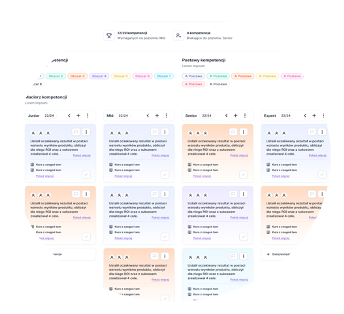
For managers and HR teams, the implementation meant access to reliable, up-to-date data on employee competencies. In place of self-declarations and evaluation sheets, a cohesive view of actual skills, competency gaps, and risk areas emerged.
The manager dashboard enables real-time responses to competency deficits, the planning of development initiatives, and better alignment of training with team needs. Decisions regarding development, promotions, or role changes shifted from being intuition-based to data-driven.
Implementation Results
The bank gained a standardized digital competency assessment process that can be scaled and repeated in other areas. Employees received clear expectations and specific development guidance, while managers gained a tool for the conscious management of team competencies.
As a result, digital competencies ceased to be an abstract concept and became a measurable element of organizational development, linked to real work and specific tasks.
If your organization is facing a similar challenge – contact us.
Best regards,
Beata